Fungus (plural ‘fungi’) are a species of organisms that get their food from decaying material or other living things. There are different types of fungi, such as yeasts, rusts, smuts, mildews, and moulds.
Mould and mildew are a type of fungi commonly found in moist places. One of their significant features is that they tend to spread quickly and, if left unattended, can damage property or create health issues.
One may consider mould and mildew as brothers as both belong to the general classification of fungi, have similar attributes, thrive in moist areas and are harmful to health.
Key Takeaways
- Mold is a fungus that grows in multicellular filaments called hyphae, forming large, visible colonies, while mildew grows in flat patterns and is less extensive.
- Mold can be of various colors and textures, while mildew is white or gray and has a powdery or downy appearance.
- Both mold and mildew thrive in damp environments and can cause damage to surfaces or materials, but mold is more harmful, potentially causing structural damage and health issues.
Mould vs Mildew
The difference between mould and mildew lies in their appearance and growth. While mould is green or black and grows under any wet surface, mildew is white or yellow and grows on the surface. However, the above is not the only difference. A comparison between both terms on specific parameters can shed light on subtle aspects.

Comparison Table
| Parameter of Comparison | Mould | Mildew |
|---|---|---|
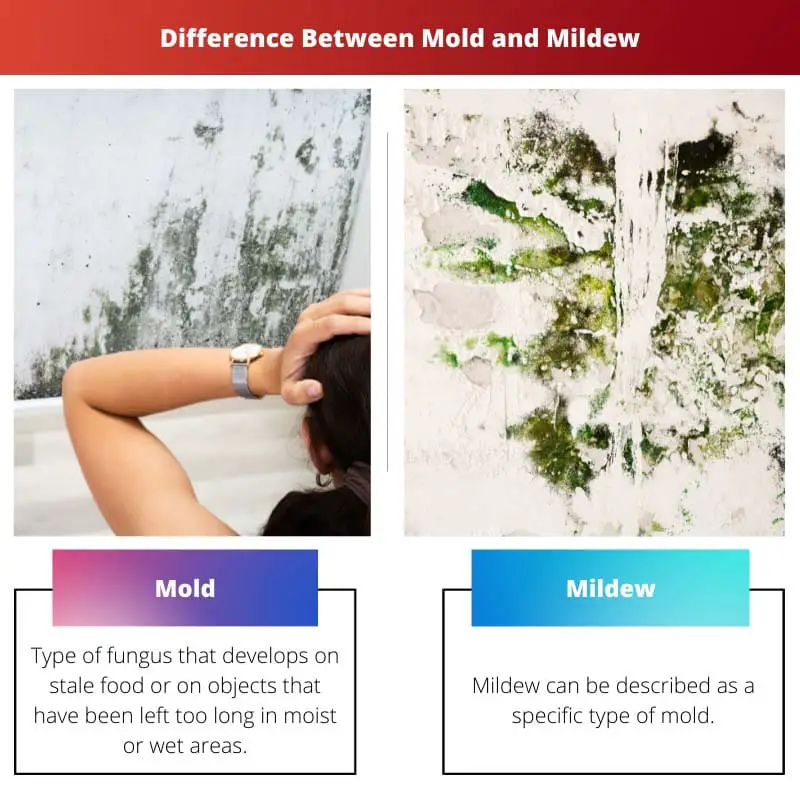
| Description | Type of fungus that develops on stale food or on objects that have been left too long in moist or wet areas | Mildew can be described as a specific type of mould |
| Colour | Green or black | White |
| Texture | Fuzzy, slimy | Fluffy, powdery |
| Where found/seen | Usually underneath a surface. Grows on food | On a moist surface. Seen on walls, damp surfaces, leather, clothing, ceilings |
| Pattern of growth | Grows as irregularly shaped spots | Grows in a regular flat pattern |
| Types | Alternaria , Aspergillus, Penicillium, Stachybotrys chartarum and many others | Powdery mildew, downy mildew, aspergillus and many others |
| Generally classified as | Fungi | The specific type of mould |
| Uses | Food production, drug production | None |
| Which is more harmful | Mould is more harmful as it can grow on food | Less harmful as it is easy to remove since it grows on the surface |
| Why harmful/less harmful | Releases toxins | It affects plants and crops, and walls and is easier to eliminate |
| What is commonly affected | Food | Plants and crops |
| Could the underlying surface be affected | If grown on food, the food will be spoilt | The walls, and ceilings will not be affected |
| How to prevent | Not keeping perishable food for many days | Using mildew removers |
What is Mold?
Mold is a fungi growth at home, on food or other slightly wet or humid surfaces. For example, one may see green growth on stale bread at home.
The standard varieties of mould include Alternaria Aspergillus, Cladosporium, and Penicillium.
Mould requires a moist place to grow. Mould grows in an irregular or circular fashion on a surface. The colour of the mould is either green or black and bears a slimy texture or, at times, downy.
Mold can cause detrimental consequences if one eats any food containing mould. Even the surfaces where there is the growth of mould begin to rot.
Also, prolonged exposure to mold can be fatal from a health perspective and cause serious long-term issues such as heart problems, depression, asthma, pressure, and extreme fatigue.
Mold can leave lasting damage on the surface on which it spreads. Though molds are harmful, some are used in food and drug production or to improve flavour.
Examples include yeast, and Penicillium.

What is Mildew?
Mildew is a type of fungus which grows on plants, crops, walls, paper, and cloth, under wet and moist conditions. Ideally, one may observe mildew on walls, ceilings or any surface which is wet for some time (so it can be called ‘surface fungi’).
Mildew is also classified as a type of mould. Mildew will appear in white or grey colour. There are multiple types of mildew.
The common ones include powdery mildew, downy mildew, aspergillus, rhizopus, etc.
The ideal month for the growth of mildew is during the winter season when people have a tendency to close their windows and humidity rises. If mildew is left unattended, it can be harmful to health as inhalation can cause cough, headache, and respiratory problems.
But the best part is that mildew can be eliminated easily through multiple ways, such as cleaning the surfaces, using mildew removers, scrubbers, etc., to clean and wipe the surface.
One does not need to replace the entire surface of the item as the surface will not get damaged by mildew. There is less possibility of someone getting seriously harmed due to mildew due to its easier elimination being feasible.

Main Differences Between Mold and Mildew
- Mold is a type of fungus, green or black in appearance and with a fuzzy or slimy texture. Mildew is a specific type of mold, in white, grey or yellow colour and with a fluffy or powdery texture.
- Mold grows underneath the surface of anything that has got wet or moist, ideally can be seen on perished food items. Mildew thrives on moist or damp surfaces such as bathrooms, walls, ceilings, damp surfaces, paper, and fabrics.
- Mold appears as irregularly shaped spots with different colours – blue, green, etc. Mildew will appear to grow in a flat pattern.
- Mold may be used in food production; for example, penicillium is utilized for cheese making. Mildew may not be used for any food-related purpose.
- Mold can be prevented by keeping all areas in the home dry and free of moisture and not keeping perishable foods for too long. To prevent mildew, one can use mildew removers, using mildew-resistant seeds, and fungicides.
- The smell of mold is that of a pungent rotting wood or paper, accompanied by the release of harmful toxins. Mildew has a stale or damp smell.