Revenue and Profit are terms frequently utilized reciprocally anyway. They are unique and are determined in an alternate manner prior to being displayed in the books of records.
Basically, All returns assembled distinctly from the organization’s centre business activities are qualified to be important for an organization’s income.
Key Takeaways
- Revenue is the total amount of money a company earns from sales and other income sources.
- Profit is the remaining amount after deducting all business expenses from revenue.
- Companies must generate sufficient revenue to cover expenses and achieve a positive profit for financial sustainability.
Revenue vs Profit
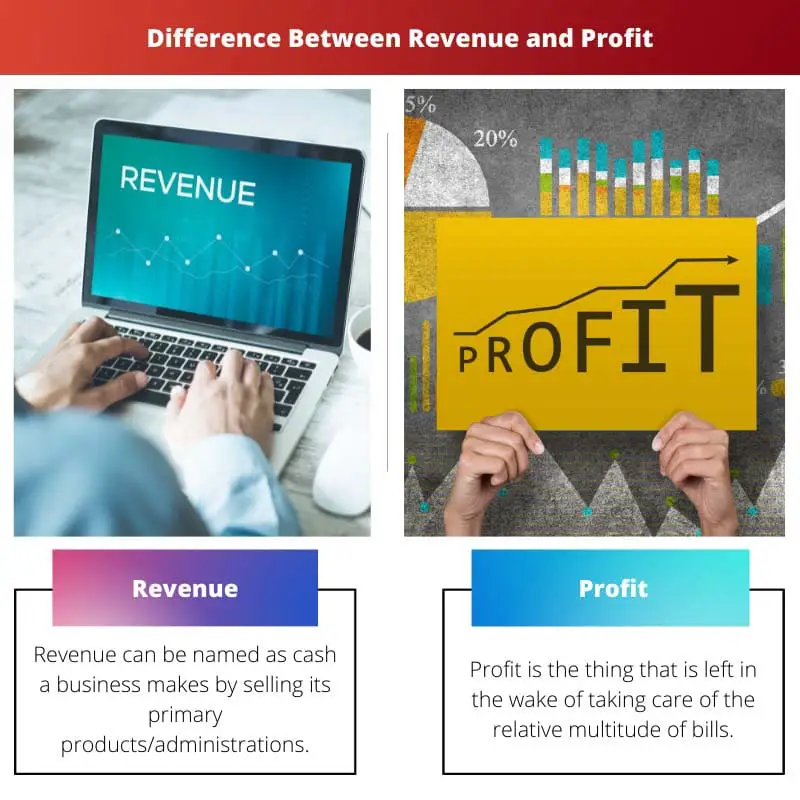
The difference between Revenue and Profit is that Revenue can be named as cash a business makes by selling its primary products/administrations, while Profit is the thing that is left in the wake of taking care of the relative multitude of bills.
Revenue called Deals, Deals Revenue, Turnover, Net Pay, Top Line. It is the measure of cash a business acquires by selling its primary products and administrations to its clients.
All returns accumulated uniquely from the organization’s central business activities are qualified to be important for an organization’s revenue.
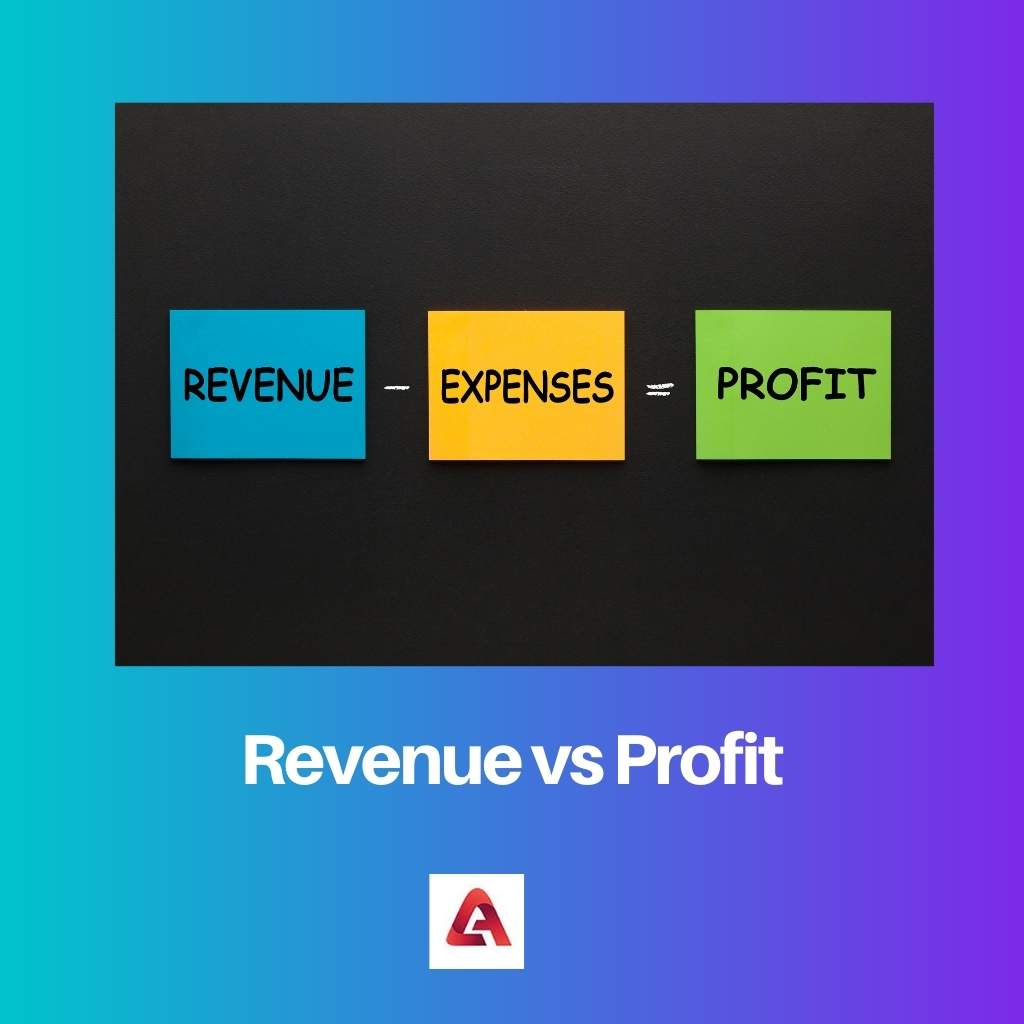
Profit is called Primary concern, Net Benefit, or Net Profit. Profit is the thing that is left after the allowance of all costs from income. Profits can be determined at different levels, for example, Net Benefit, Net Benefit, and so forth. According to a more extensive viewpoint, Benefit = Income – Costs.
Comparison Table
| Parameters of Comparison | Revenue | Profit |
|---|---|---|
| Objective | Cash acquired by selling primary products or potentially administrations to customers. | Net Profit of a business left after derivation, everything being equal. |
| Formula | Revenue = Absolute Deals – Complete Returns | Profit = All out Income – All out Costs. |
| Other Names | Otherwise called Deals, Deals Income, Turnover, Net Income | Otherwise called Main concern, Net Benefit, Net Profit. |
| Display | It is displayed in Exchanging Account. | It is displayed in Pay Articulation |
| Meaning | Revenue can be named as cash a business makes by selling its primary products/administrations. | Profit is the thing that is left in the wake of taking care of the relative multitude of bills. |
What is Revenue?
Revenue can be perceived as the returns obtained by the organization from its essential and auxiliary business exercises in a given period.
Implying that the pay produced by the organization because of the offer of merchandise or conveyance of administrations or some other utilization of the organization’s capital or resources in association with its essential business exercises preceding the derivation of any expenses or costs will be named as Revenue.
The Revenue created from the offer of products or conveyance of administrations is viewed as a “Turnover.”
In the Pay proclamation of the organization, the Revenue showing up on the top line is its business Revenue/administration Revenue (by and large) for the concerned period, from which the expense of information sources, costs, interest on obligation, and charges are deducted to decide the net benefit.
Revenue is the backbone of the business since it helps in gathering the fixed and variable costs of the firm. It assists the organization with maintaining its business successfully and proficiently.
Non-working Revenue: The pay created through different exercises of the business, which are attempted next to each other, is called non-working Revenue. These are non-repeating in nature, too, as they can’t be anticipated – if the Revenue will be produced.
It might incorporate the offer of resources, the offer of scrap, the commission got, premium got, profit got, lease got, and so on.

What is Profit?
In straightforward words, Profit is the monetary profit. It is the return for the danger taken and the cash spent in the beginning and working the business.
The piece of the organization’s income left subsequent to deducting all the expenses of material, work, hardware, lease, interest on acquired capital, and assessments are called Profit.
At the end of the day, we can say that it is the excess sum that is accomplished when the pay procured from the business tasks is more noteworthy than coordinating with costs for the period.
The Profit procured is the prize for the entrepreneurs. It is fundamental for the development and long-haul endurance of each business. Indeed, the accomplishment of the business depends just on its Profit procuring limit.
Every one of the partners is keen on realizing the Profits made by the organization in the given time frame.
Profit is obtained subsequent to deducting the creation costs, overheads, premiums, and assessments required from the Income acquired in the concerned period.
Working Profit: The Profit stayed in the wake of deducting working costs yet before the allowance of interest and charges is called working Profit.
Here working costs suggest the costs brought about by undertaking typical business exercises, however are not straightforwardly identified with creation. These incorporate office and organization costs, selling and dispersion costs, and so on.

Main Differences Between Revenue and Profit
- Cash is acquired by selling primary products or potential administrations to customers, while the Net Profit of a business is left after derivation, everything being equal.
- Revenue = Absolute Deals – Complete Returns while Profit = All out Income – All out Costs.
- Otherwise called Deals, Deals Income, Turnover, Net Income, while otherwise called Main concern, Net Benefit, or Net Profit.
- Revenue is displayed in Exchanging Account, while Profit is displayed in Pay Articulation.
- Revenue can be named as cash a business makes by selling its primary products/administrations, while Profit is the thing that is left in the wake of taking care of the relative multitude of bills.
The detailed explanation of revenue and profit’s definitions, as well as the practical examples provided within this post, are noteworthy.
This piece is a great starting point for those wanting to understand the essential financial concepts of revenue and profit.
I completely agree, Kieran. The inclusion of practical examples enhances the understanding of these concepts.
Understanding the difference between revenue and profit is crucial for business owners and anyone interested in financial matters. This post does a great job breaking down the two, explaining them thoughtfully.
I agree, Amanda. It’s important to have a clear understanding of financial terminology and concepts to make informed decisions.
Revenue and profit are confused, but they are indeed different. The examples and definitions provided here are very helpful in clarifying the distinction.
This post serves as an informative guide for those seeking to gain a deeper understanding of revenue and profit.
Absolutely, Aclark. The line-by-line comparison table is particularly useful in presenting the contrasts.
The clear and concise elucidation of revenue and profit, along with the examples and distinguishing features, makes this post a valuable learning tool for individuals interested in financial matters.
Absolutely, Benjamin Reynolds. The post effectively captures the critical elements of revenue and profit.
I couldn’t agree more. It’s a well-structured educational piece that adds clarity to these financial concepts.
The post is a comprehensive guide that’s beneficial not only for students but also for professionals. It provides a thorough understanding of revenue and profit.
I agree, Riley Mitchell. The content offers clarity on revenue and profit, making it suitable for a wide audience.
This is a well-informed piece that effectively explains the fundamental aspects of revenue and profit.
The detailed insights into the importance of revenue and profit, along with their definitions, provide a well-rounded understanding of these key financial concepts.
Absolutely. The post effectively captures the essence of revenue and profit, making it an invaluable resource for learning.
This post’s comprehensive explanation of both revenue and profit, along with the comparison table, makes it a valuable resource for those studying or working in finance.
I couldn’t agree more, Steve40. It’s a highly educational piece that’s beneficial for various stakeholders.
The clear delineation between revenue and profit is well-articulated, making the subject matter easy to comprehend.
The detailed explanation and description of revenue and profit in this post present a clear distinction between the two, enhancing the reader’s knowledge.
This post’s articulation of the concepts is exceptional, providing a comprehensive understanding of revenue and profit.
Absolutely. This resource is highly informative and beneficial for those seeking to understand the nuances of revenue and profit.
The post’s breakdown of the various names and terms associated with revenue and profit, in addition to the meaning and significance of each, is extremely helpful for readers.
I couldn’t agree more. It’s commendable how the post covers these aspects comprehensively.
Absolutely, Andrew Wilkinson. Understanding the significance of these terms under different names adds depth to the knowledge of revenue and profit.
The insightful content elucidating the definitions and comparisons between revenue and profit offers a comprehensive insight into these financial concepts.
I share that sentiment, Gprice. This content serves as a valuable educational tool.